
TERRAQ SYSTEM
Continuous in-situ root-zone sensing.
TerraPod multi-parameter sensor hubs and TerraNode solar field stations — measuring pH, nitrate, ammonium, potassium, soil moisture, and temperature directly in the root zone. Continuously. Wirelessly. Without mains power or civil works.
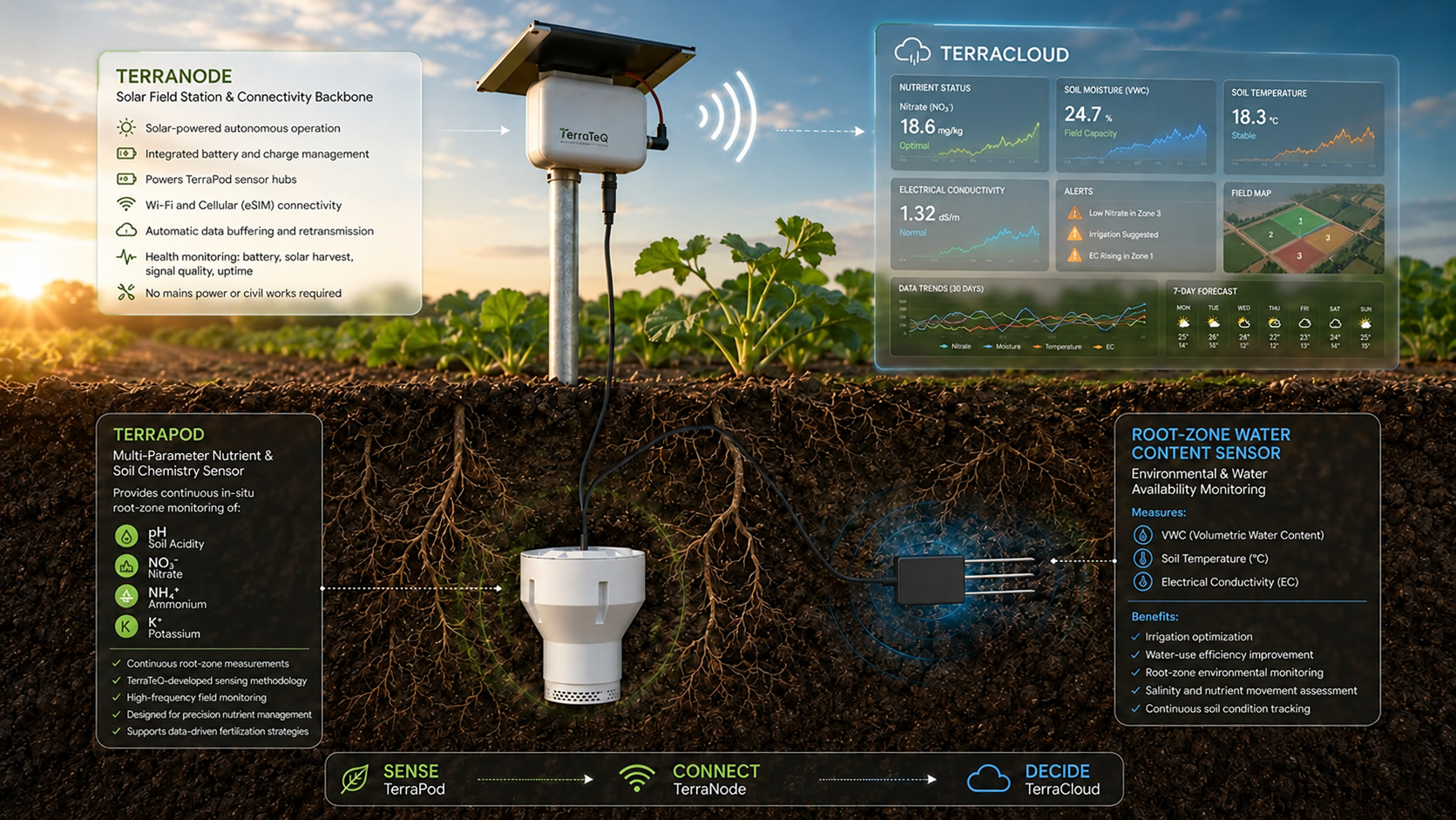
Direct in-situ measurement of soil chemistry. Field trials active · Pilot deployments being onboarded now.
01 — SYSTEM OVERVIEW
Three components. One integrated system.
Designed to work as a complete stack — from sensor to decision.
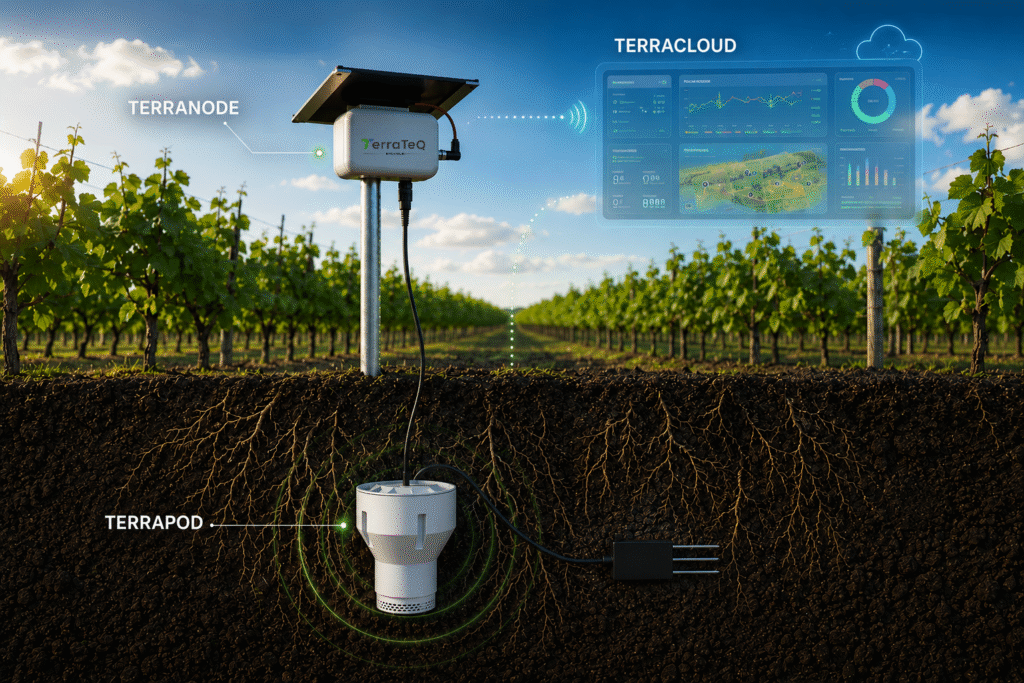
The TerraQ System delivers continuous, multi-parameter root-zone measurement directly at the point where soil conditions determine crop performance. TerraPod measures. TerraNode powers and connects. TerraCloud visualises and processes.
Each component is engineered around the constraints of real field deployment — power availability, connectivity, serviceability, and measurement accuracy across variable soil types and growing environments.
SENSE
TerraPod
Root-zone sensor hub
CONNECT
TerraNode
Solar field station
DECIDE
TerraCloud
Data platform
COMPONENT 01 – TERRAPOD
Multi-parameter root-zone sensor hub.
Six parameters. Simultaneously. In-situ.
TerraPod is deployed directly in the root zone, per irrigation zone. It measures six soil parameters simultaneously and continuously — transmitting data wirelessly via TerraNode to TerraCloud at configurable intervals.
TerraPod uses TerraTeQ’s in-situ methodology for measuring soil chemical parameters — enabling direct measurement of nitrate, ammonium, and potassium in the root zone, rather than relying on extracted or estimated values.
The modular cartridge architecture supports field replacement of sensor elements without removing the housing — enabling predictable maintenance cycles and consistent performance across growing seasons.
KEY CAPABILITIES
- Six parameters measured simultaneously — not sequentially
- Adjustable sampling cadence — typically every 5 minutes to several days
- Offline data buffering — auto upload on connectivity restore
- Modular sensor cartridges — field-replaceable without housing removal
- Guided single or dual-point calibration with full audit trail
- Zone-based deployment — one hub per irrigation zone for independent monitoring
- Weather-sealed, field-serviceable housing
- Powered and connected via TerraNode
PARAMETERS MEASURED
pH
Soil acidity
NO₃⁻
Nitrate
NH₄⁺
Ammonium
K⁺
Potassium
VWC
Soil moisture
°C
Temperature
TECHNICAL SPECIFICATIONS
COMPONENT 02 – TERRANODE
Solar field station and connectivity backbone.
Infrastructure-free deployment. Season-long uptime.
TerraNode is a compact solar-battery field station that powers TerraPod and relays its data to TerraCloud. A PV panel with battery and charge management provides stable, autonomous power — eliminating the need for mains infrastructure or scheduled power maintenance.
Data is transmitted via dynamic switching between Wi-Fi and cellular (eSIM) — maintaining connectivity across variable field conditions. If the link is temporarily interrupted, data is buffered locally and uploaded automatically on restore. No manual intervention required.
TerraNode also reports its own health telemetry — battery level, solar harvest, link quality, and uptime — so operational issues are visible before they affect data continuity.
TECHNICAL SPECIFICATIONS
KEY ADVANTAGES
- No mains power or civil works required — deploy in any field location
- New monitoring zone live in hours, not weeks
- Scalable — add zones independently as deployment expands
- Health checks visible before issues affect data continuity
02 — APPLICATIONS
Validated deployment environments.
The TerraQ System is designed and tested for a range of agricultural and research environments.
Greenhouse Horticulture
Multi-zone root-zone monitoring for tomatoes, cucumbers, peppers, and other controlled-environment crops.
Vineyards & Orchards
Per-block root-zone monitoring across variable soil and irrigation conditions in permanent crop systems.
Open-Field Vegetables
Zone-based sensing across high-value open-field crops where irrigation and fertigation precision are critical.
Research & Trials
Agronomic validation trials and research plots requiring continuous, spatially-resolved root-zone data.
Remote & Off-Grid Sites
TerraNode solar power enables deployment where mains infrastructure is unavailable or impractical.
Advisory & Cooperatives
Consistent sensing infrastructure across multiple grower sites managed through a single TerraCloud account.
03 — WHY PILOT NOW
We are building this with our partners, not for them.
TerraTeQ is at an active deployment stage — validating the TerraQ System and TerraCloud DSS across real soil types, crop systems, and field conditions. Real field data from real growing environments is the one thing we cannot generate in a lab. This is the right moment to get involved.
- ✓TerraPod and TerraNode deployed and maintained on your site by TerraTeQ
- ✓Full TerraCloud access — Standard or Pro — from day one
- ✓Dedicated engineering support throughout — included in your subscription
- ✓Direct input into what the platform builds next
- ✓Real soil data across diverse crops and conditions to validate the DSS
- ✓Operational feedback that directly shapes development priorities
- ✓A commercial relationship to develop into a long-term subscription
- ✓A reference deployment and case study
- ✓A platform built on actual field evidence, not lab assumptions
- ✓Technology validated in your specific soil, crop, and climate
- ✓A shared stake in making it work — for your operation and beyond
- ✓Early access to new platform capabilities as they are released
04 — PILOT PROGRAMME
Join our pilot programme.
TerraTeQ is actively seeking growers, vineyard operators, greenhouse producers, and research institutions to join our pilot programme. Pilots are structured around a TerraCloud subscription — we deploy and maintain the TerraQ hardware on your site, you get full platform access and engineering support from day one. We work with a small number of partners at a time, selected for fit, to ensure quality of support and depth of engagement.
- ●TerraPod and TerraNode deployed across agreed monitoring zones
- ●Full TerraCloud access for the pilot duration
- ●Installation, calibration, and technical onboarding by TerraTeQ
- ●Engineering support throughout the deployment period
- ●Structured data review sessions with the TerraTeQ team
- ●Priority access to new platform features as they are released
- ●Greenhouse vegetable producers — tomatoes, cucumbers, peppers
- ●Vineyard and fruit orchard operators
- ●High-value open-field vegetable growers
- ●Research institutions and agronomic validation programmes
- ●Partners willing to share operational feedback honestly
- ●Operations with at least one full growing season ahead
Pilot deployments are structured around a TerraCloud subscription. TerraTeQ deploys, calibrates, and maintains all hardware on your site — you get full platform access and dedicated engineering support from day one. Pilot slots are limited — we are onboarding now.
Apply to Join →05 — GET IN TOUCH
Tell us about your operation.
We will give you a direct assessment of whether the TerraQ System is right for your site — and whether a pilot deployment makes sense. No sales pitch. Just an honest conversation.